Why overthinking is a learned response, not a personality trait
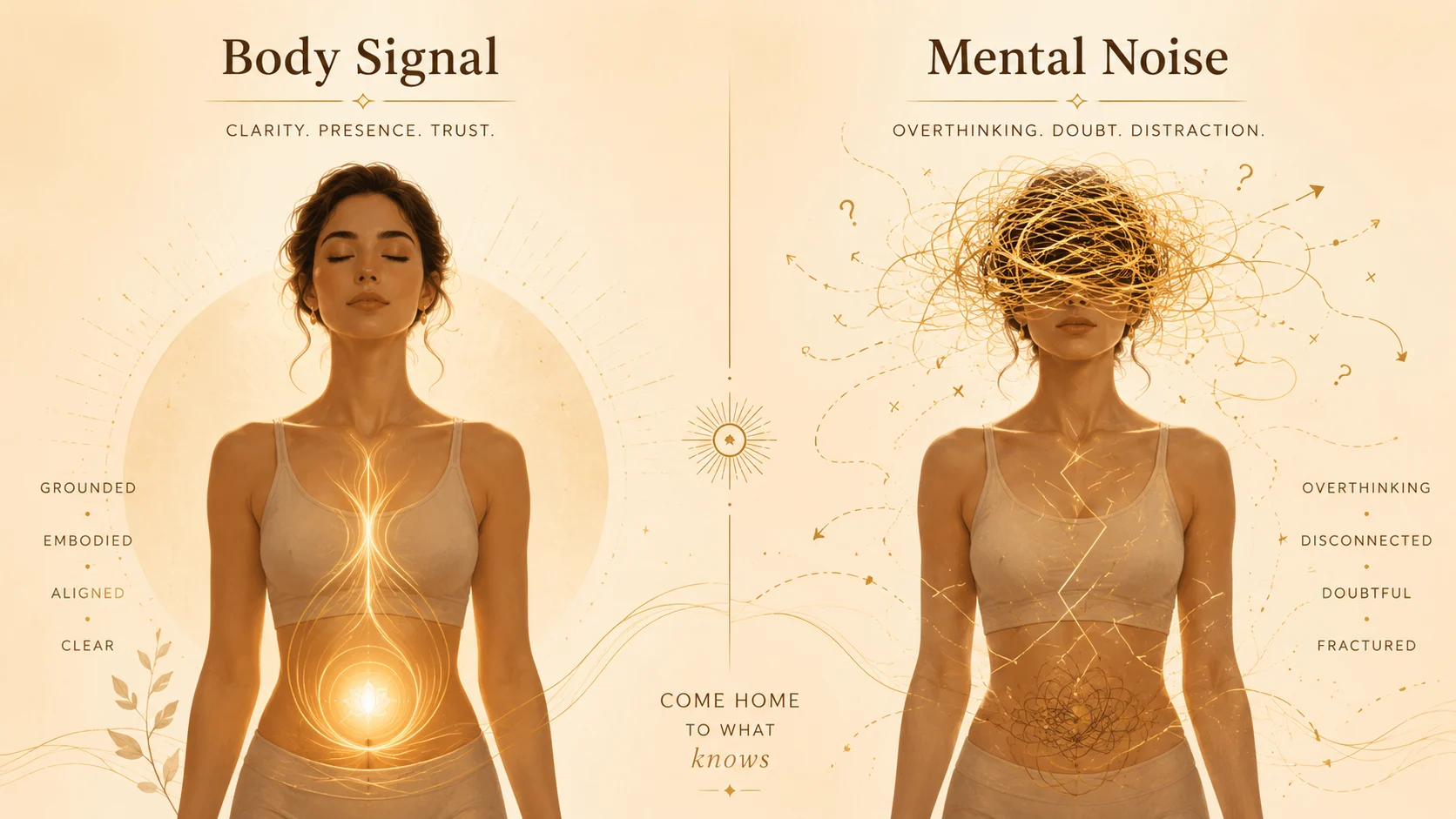
Overthinking gets labeled a personality trait — "I'm just someone who overthinks" — but it's almost always a response to a specific experience: learning that your immediate knowing couldn't be trusted. That learning might have come from early environments where your instincts were dismissed or corrected. From educational systems that trained you to always show your reasoning. From relationships where your gut led you somewhere painful. From a culture that equates analysis with intelligence and spontaneity with immaturity.
The mind picks up these signals and adjusts. It learns to run every decision through an exhaustive analysis before committing — because commitment without analysis has felt unsafe. This is an adaptation, not a character flaw. But it's an adaptation that has a cost: the further you drift from your immediate knowing, the harder it becomes to trust yourself about anything. The analysis becomes a substitute for knowing, and eventually, no amount of analysis produces the certainty you're looking for.
NoteOverthinking is most common in people with many undefined centers in their Human Design chart — which means they absorb and amplify the energy and thinking of others. This makes the mental noise even louder.
The role of conditioning in silencing body-based knowing
In Human Design, undefined centers are where you're most susceptible to conditioning — absorbing the energy, beliefs, and patterns of others and mistaking them for your own. People with many undefined centers often have very active minds, precisely because they're processing so much input from the outside world. This isn't a weakness. But it does mean that distinguishing your own signal from the noise requires more practice.
Conditioning silences body-based knowing by creating a hierarchy where the mind is at the top. "I think, therefore I know." But the body has access to information the mind doesn't — immediate, pre-cognitive responses to people, environments, decisions, and opportunities. When conditioning teaches you to override these responses, you lose access to a significant source of intelligence. The practice of reconnecting with body-based knowing is partly a practice of deprogramming: learning to notice the first response before the mind overrides it.
→ The different types of inner authority in Human Design
The difference between thinking about a decision and feeling it
The mind and the body give you different kinds of information about a decision. The mind gives you analysis: risk assessment, logical projections, cost-benefit calculations. These are useful. But they don't tell you whether this is genuinely right for you — because "right for you" isn't a logical category. It's an experiential one.
The body gives you something different: an immediate, pre-cognitive response that shows up as physical sensation. Expansion or contraction. Lightness or heaviness. A pull toward or a push away. A sense of aliveness or flatness when you imagine saying yes. These sensations are often dismissed as "just feelings" — which is exactly backward. These are the body's most reliable signals. The mind's analysis, by contrast, can justify almost anything. A skilled overthinker can construct a compelling argument for any decision — which is precisely why the analysis loop never ends: because logic alone can't resolve what was never a logical question.
How to create conditions for your inner signal to speak
The inner signal doesn't compete well with mental noise. It's typically quieter, slower, and more subtle than the mind's analysis. Creating conditions for it to speak means reducing stimulation and creating space where the body can be heard.
Practically: before making a significant decision, take yourself out of the immediate context. Walk, sit quietly, lie down, or do something physical that doesn't require mental engagement. Give yourself a specific question to hold — not to answer analytically, but to notice what your body does with it. Does the thought of saying yes feel expansive or contracting? Does the thought of saying no feel like relief or like loss? These aren't magic techniques. They're simply ways of getting quiet enough that the signal you've been overriding can be heard. The more you practice this, the faster and clearer the signal becomes.
Pro tipThe body often responds to the question 'what would I choose if I weren't afraid?' much more clearly than it responds to 'what should I do?' Try both and notice the difference.
→ Sacral authority: how generators and MGs hear their gut
What to do when the signal is unclear
Sometimes you create the conditions, ask the question, and still get nothing clear. This is normal, and it usually means one of three things. First: you may not have waited long enough. For people with emotional authority, clarity requires moving through the emotional wave, which takes time. Second: this may not be the right moment for the decision. Sometimes the body's "no" to deciding now is itself the signal. Third: there may be competing forces — wants, fears, obligations — that are muddying the water and need to be named before the signal can come through.
In all of these cases, the answer is the same: don't force it. Forcing a decision when the signal is unclear produces the lowest quality outcome. If at all possible, wait. If you genuinely can't wait, choose based on values — what do you care about most, independent of the outcome? — and notice what you learn from the result. Every decision teaches you something about your signal. Over time, the language becomes clearer. The threshold between genuine knowing and mental noise becomes more distinct. That's the practice.
→ Emotional authority: why waiting is not weakness
Key takeawayClarity about decisions isn't something you think your way to. It's something your body arrives at, on its own timeline. Your job is to create the conditions for that to happen.
Understanding why you overthink is step one. The practice of stopping is another.
That's the work we do in 1:1 coaching — not in theory, but in the actual decisions you're facing right now.
Book a free discovery call
30 min · Free · English or French