The emotional wave: what it is and how it works
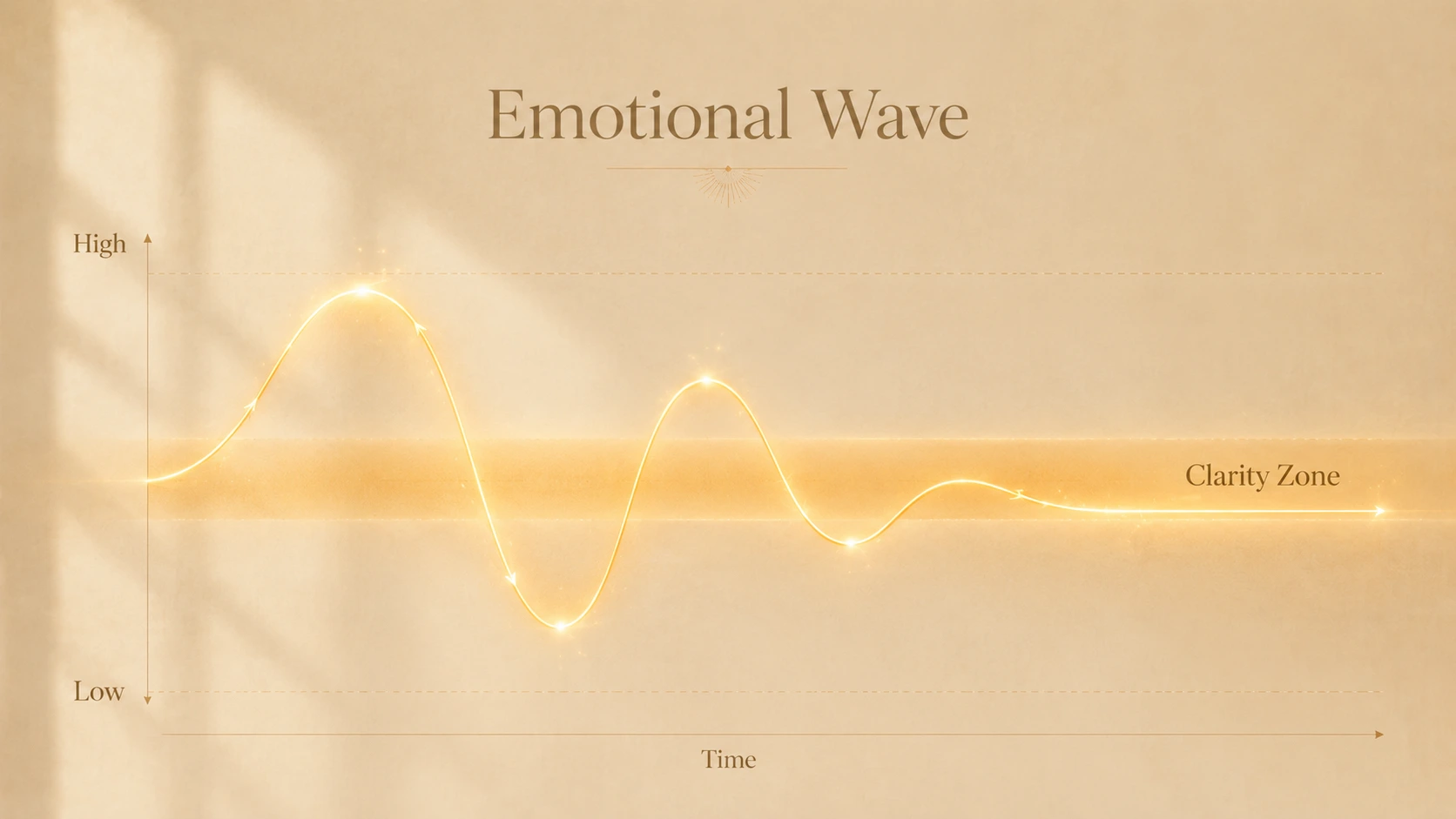
The solar plexus center — when defined — generates a continuous emotional wave. This wave isn't linear: it moves through highs and lows, enthusiasm and flatness, clarity and fog. If you have emotional authority, you live this wave constantly. Most people with emotional authority have spent their lives either chasing the highs or trying to escape the lows, not realizing that the wave itself is the mechanism of their knowing.
The wave is not the same for everyone. Some people have a wave that oscillates gently. Others have sharp peaks and deep valleys. Some waves cycle quickly; others take days or weeks to move through. Getting familiar with your specific wave pattern — its rhythm, its range, its triggers — is foundational to using emotional authority well. You can't navigate something you haven't mapped.
Why emotional authority people make their worst decisions at peaks and valleys
At the peak of the emotional wave, everything feels possible. The thing in front of you seems perfect, the timing feels right, the enthusiasm is genuine and contagious. This is exactly when emotional authority people are most likely to say yes — and most likely to regret it. The peak is not clarity. It's excitement. And excitement distorts perception as reliably as fear does.
At the valley, the opposite happens. Nothing seems worth doing. The same opportunity that looked perfect two days ago looks empty. You wonder why you were ever interested. This is not discernment — it's the low end of the wave. Decisions made from the valley tend to be the closings, the withdrawals, the sudden ends of things that actually had potential. The valley feels like honesty, but it's as distorted as the peak. Clarity in emotional authority isn't at either extreme. It lives in the neutral middle — a quiet, settled sense that this is still right, even without the charge.
Pro tipTrack your emotional state for 30 days before trusting your wave to guide decisions. The pattern needs to be familiar before you can use it reliably.
How to recognize when you have enough clarity
Emotional authority doesn't come with a clear signal that says "you're ready to decide now." It comes with an absence of distortion. At the peak, there's excitement. At the valley, there's heaviness. When the wave has moved enough that neither of those is dominating — when you can think about the decision without feeling charged in either direction — that's usually where clarity lives.
For most emotional authority people, this means sitting with significant decisions for at least a few days. For major decisions — life partners, significant business commitments, relocations — it may mean weeks. This doesn't mean you can't act quickly in situations that require it. But for anything that will have lasting consequences, the quality of your decision is almost always worth the cost of the delay.
→ How to stop overthinking and trust your body's signal
What "sleeping on it" actually means for emotional authority
The common advice to "sleep on it" before making a big decision is actually a piece of folk wisdom that aligns with emotional authority. But it doesn't go far enough. One night often isn't enough to move through the wave. What "sleeping on it" really means, for emotional authority types, is waiting through at least one complete emotional cycle — which might take three days, a week, or longer.
The practice: when a significant decision appears, don't decide immediately. Notice how you feel about it today. Then notice tomorrow. And the day after. If you feel consistently positive without the initial rush of excitement — if the yes is still there when the high has faded — that's a more reliable signal than any amount of in-the-moment certainty. If the yes disappears entirely when the wave drops, that tells you something too.
Practical scenarios: using emotional authority in business and relationships
In business: you receive an invitation to collaborate on a project, or a client asks you to take them on immediately. If you have emotional authority, your answer in the moment — however confident it feels — is not your most reliable answer. "I need a few days to sit with this" is not indecision. It's your operating system working correctly. The people worth working with will respect this. The ones who don't tolerate any delay are often the highest-risk commitments.
In relationships: someone says or does something that triggers a strong emotional reaction. The emotional authority person's first impulse is to respond from the peak or valley — to commit, to withdraw, to resolve things immediately. The practice is to notice the charge, name it internally, and wait. Not to suppress emotion or avoid the conversation, but to avoid making lasting commitments in the middle of a wave. The conversation that happens when the wave has settled is almost always more useful than the one that happens in the middle of it.
Key takeawayEmotional authority is not about being slow or indecisive. It's about being accurate. The time cost of waiting is almost always less than the cost of committing from distortion.
Living your emotional authority is harder than understanding it.
In 1:1 coaching, we work with your authority in the context of real decisions — not theory.
Book a free discovery call
30 min · Free · English or French