What is a Human Design chart?
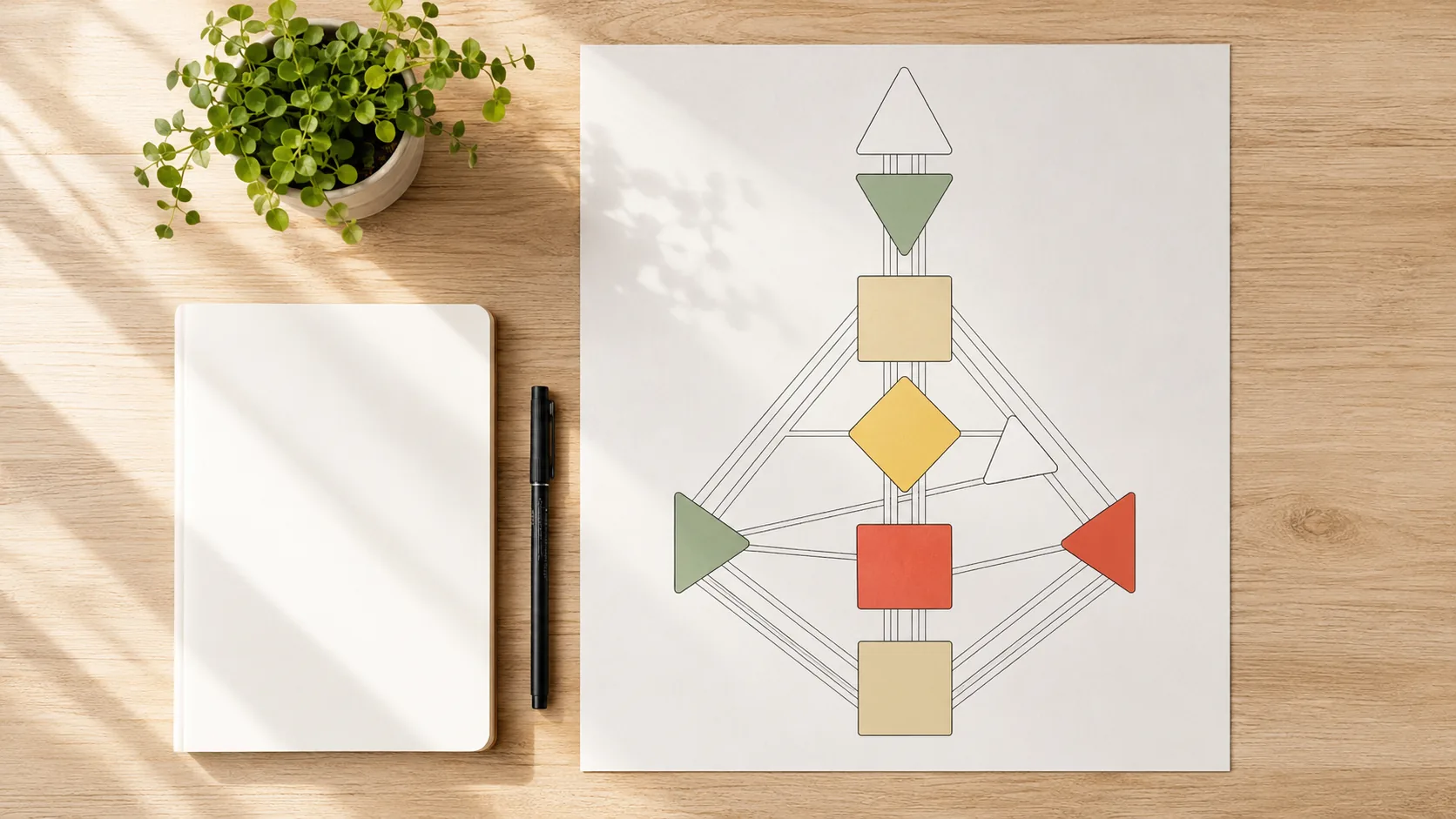
A Human Design chart, called a BodyGraph, is generated from your birth data: date, time, and place of birth. It maps where the planets were positioned at the moment of your birth and approximately 88 days before it, then cross-references those positions with the 64 hexagrams of the I Ching.
The result is a nine-centered figure that shows which parts of your energy field are consistently active (defined) and which are variable, open to influence from your environment and the people around you.
It's not a horoscope. It doesn't predict events. It describes how you're wired to operate.
To generate your chartYou need your birth date, birth time (as precise as possible), and city of birth. Free chart calculators are available at mybodygraph.com and jovianarchive.com. The time matters: even an hour's difference can shift the chart meaningfully.
Your Type: how you're wired to move through the world
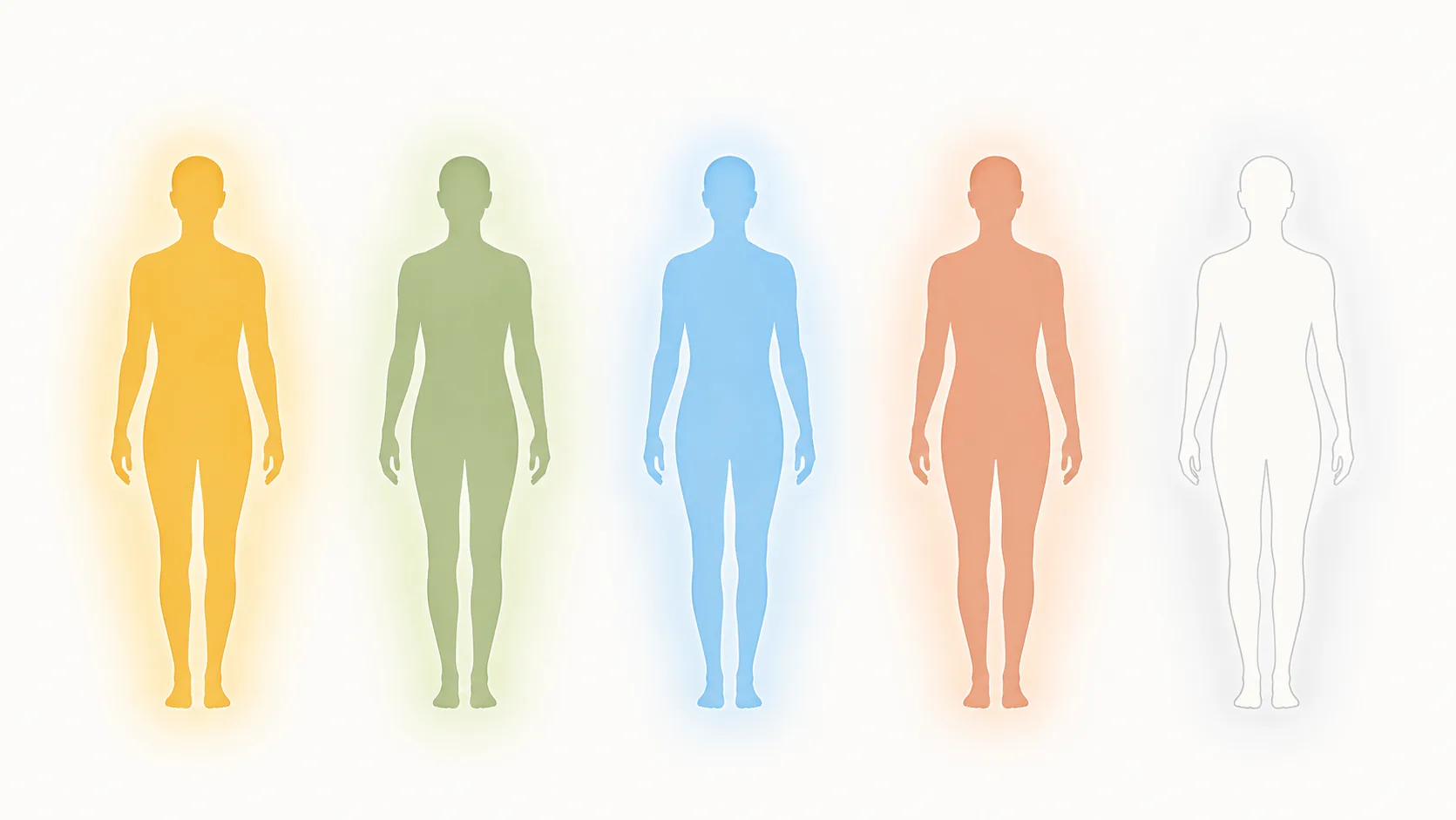
Type is the first thing most people look at, and for good reason. There are five Types in Human Design: Generator, Manifesting Generator, Projector, Manifestor, and Reflector. Each one describes a fundamentally different way of engaging with work, decisions, and energy.
Generator (roughly 37% of the population): built to respond. Sustainable life force energy. The Generator's strategy is to wait for something to respond to, rather than initiating from the mind. When a Generator responds from their gut (their Sacral response), they generate momentum that doesn't deplete them.
Manifesting Generator (roughly 33%): a hybrid. Fast, multi-passionate, built to skip steps that don't serve the process. Also responds before initiating, but can move faster and sometimes out of sequence. They're often told they're "scattered" when they're actually built to operate in multiple directions at once.
Projector (roughly 20%): not built for sustained work energy. Built to guide, manage, and direct others. Their strategy is to wait for recognition and invitation before sharing their insight. Projectors who push and initiate constantly burn out faster than any other Type.
Manifestor (roughly 9%): the only Type designed to initiate. They have a repelling aura that can make others feel excluded if they don't communicate their actions. Their strategy is to inform before acting, not ask for permission, just keep people in the loop.
Reflector (roughly 1%): completely open centers. They sample and reflect the energy of their environment. Their authority is time: waiting a full lunar cycle (28 days) before making major decisions. Reflectors are barometers for the health of the communities they're in.
Your Authority: where your decisions actually come from
Authority is, in practice, more useful than Type for most people. It answers one question directly: where in your body is your reliable decision-making signal?
The mind is not an Authority in Human Design. That's not a dismissal of intelligence, it's an observation that the mind is designed to process, not to decide. The mind makes great arguments for almost anything. That's why it's not a reliable decision-making tool on its own.
Sacral Authority (Generators and Manifesting Generators): a gut response, often felt before the mind engages. It shows up as a physical sensation of yes or no, expansion or contraction, sometimes as a "mmm" sound. It's pre-verbal and direct.
Emotional Authority (anyone with a defined Solar Plexus): there's no truth in the now. Decisions made from a peak or trough of the emotional wave are unreliable. The instruction is to ride the wave, sleep on it, and decide from clarity rather than intensity.
Splenic Authority (defined Spleen, no defined Sacral or Solar Plexus): a quiet, in-the-moment signal. It speaks once and doesn't repeat itself. Learning to hear it requires slowing down enough to catch it.
Self-Projected Authority (Projectors with a defined G/Identity Center): clarity comes from hearing yourself talk through it with someone you trust. Not for advice, but to hear what you actually say when you speak out loud.
Mental/Outer Authority (Projectors with no defined Throat): also called Environmental or Sounding Board. Decisions are made by talking things through in the right environment, with people who can hold space without projecting their agenda onto the choice.
Lunar Authority (Reflectors): waiting 28 days while gathering different perspectives from different people, across different environments, and noticing what stays true through it all.
On AuthorityMost people's conditioning has taught them to decide with the mind, quickly, logically, with reasons that satisfy others. Human Design suggests a different question: where in your body do you actually feel a yes or a no, independent of what you think you should want?
Your Profile: the role you tend to play
Profile is derived from two numbers (e.g., 1/3, 2/4, 5/1) that describe a kind of archetypal role you tend to occupy in relation to others. It's less about what you do and more about the texture of how you move through life and learning.
Line 1 builds foundations through research. Line 2 has natural gifts but needs solitude to let them emerge. Line 3 learns through trial, error, and direct experience. Line 4 operates through network and personal relationships. Line 5 carries projected authority, people often see them as fixers. Line 6 lives in three distinct phases and eventually embodies what they've lived through.
Your Profile is the first number from your conscious sun (what you know about yourself) and the second from your unconscious sun (what others often see in you before you do).
The nine Centers: defined and undefined
The nine Centers in the BodyGraph each govern a domain of life: thought and conceptualization, communication and manifestation, identity and direction, willpower and ego, emotional state, life force energy, intuition and health, pressure to know, pressure to act.
A defined Center (colored in) operates consistently, regardless of who you're with. It's a fixed, reliable energy in your system.
An undefined Center (white or outlined) is open. It takes in, amplifies, and reflects the energy of defined Centers in other people. Undefined Centers are often where we feel the most vulnerable, and where we've picked up the most conditioning, trying to be what others around us are, rather than what we actually are.
Understanding your undefined Centers doesn't mean protecting yourself from input. It means recognizing when you're being amplified by your environment versus when something is genuinely yours.
What the chart doesn't tell you
The chart is a map, not the territory. It tells you how you're wired. It doesn't tell you who you are.
The gap between reading your chart and actually living from it can be significant. Most people who get a Human Design reading feel seen, sometimes moved, and then go back to making decisions the way they always have. The conditioning doesn't dissolve because you've identified it.
That's not a flaw in the system. It's just what happens when a map doesn't automatically change the terrain. Real change requires something more than information.
→ What Human Design coaching actually looks like
→ Using Human Design for better decisions
→ What is Human Design?
Want to understand your chart in the context of your actual life?
A reading gives you information. Coaching helps you live it. If you want to understand what your design means for the decisions you're making right now, a discovery call is the place to start.
Book a free discovery call
30 min · Free · English or French