The origins: where Human Design comes from
Human Design was created by Ra Uru Hu, born Alan Robert Krakower, following a mystical experience on the island of Ibiza in 1987. He described receiving what he called a transmission over eight days, which he then spent years organizing into a coherent system. Until his death in 2011, he taught and refined it continuously.
The system draws on four ancient traditions and two modern sciences. From the I Ching, it takes the 64 hexagrams, which map precisely to the 64 codons of the human genetic code. From astrology, it uses planetary positions at birth. From the Kabbalah, it borrows the structure of the Tree of Life. From the Hindu chakra system, it adapts nine energy centers. And from modern physics, it incorporates neutrino streams as the medium through which planetary information imprints on us at the moment of birth.
Whether or not you find the origin story credible, the framework has proven useful to hundreds of thousands of people as a map for understanding their own patterns. That usefulness is worth exploring on its own terms.
Pro tipYou don't need to believe in the metaphysics to find Human Design useful. Treat it as an experiment: try living according to your type and authority for 90 days and notice what changes.
The five core elements of a Human Design chart
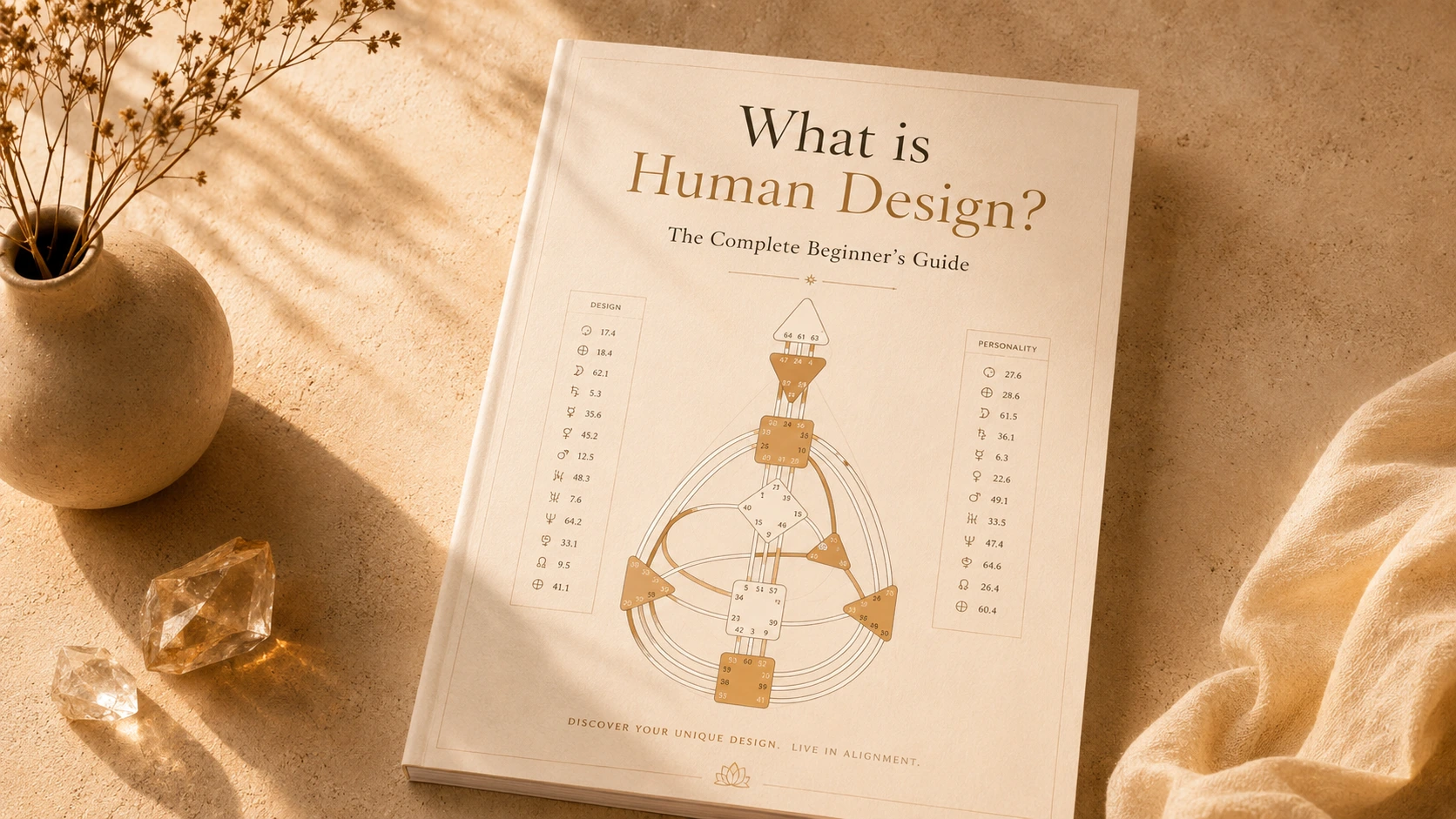
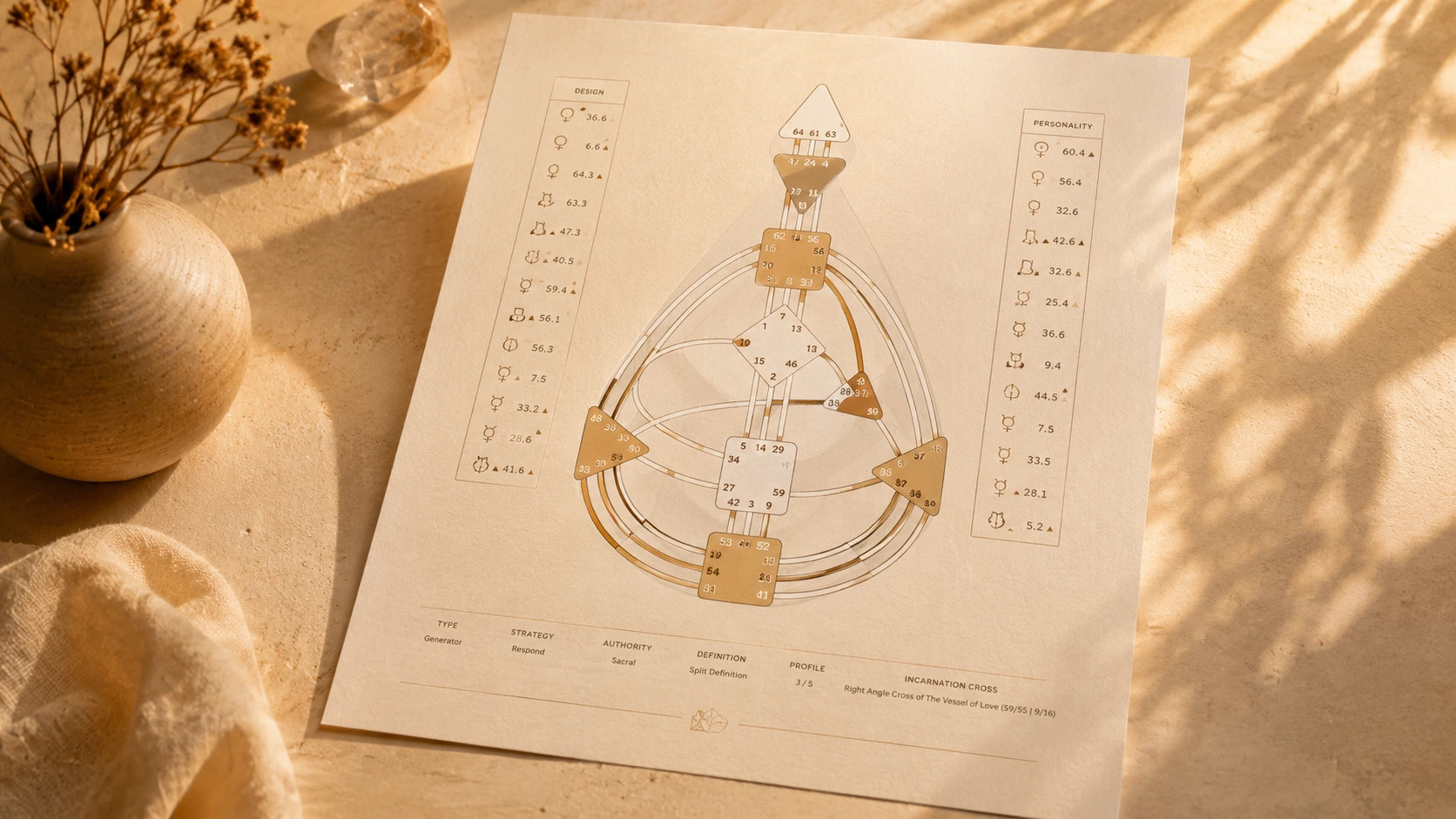
Your Human Design chart, called a BodyGraph, looks complex at first: nine geometric shapes connected by 36 channels, some areas colored and others empty. But it contains five key elements, and you only need to understand them in sequence.
Your Type is the most fundamental. There are five types, Manifestor, Generator, Manifesting Generator, Projector, and Reflector, each with a different aura, different relationship to energy, and different way of engaging with the world. Your Strategy follows directly from your type: it's how you're designed to move through life so that things flow rather than force. Your Authority is your decision-making mechanism, a consistent signal in your body that tells you what's actually right for you, independent of what your mind thinks. Your Profile describes the archetypal role you're here to play. And your Centers show which parts of your energy are consistent (defined) and which are open to conditioning from others (undefined).

→ Explore the 5 Human Design types in detail
What Human Design is, and what it isn't
Human Design is not a personality test. It doesn't predict your future, define what you can or can't do, or tell you what to think about yourself or others. It's also not a spiritual belief system that requires you to subscribe to a worldview. People with very different philosophies, skeptics, therapists, business owners, spiritual practitioners, have found it useful for different reasons.
What it is: a framework for self-knowledge that works from the body rather than the mind. Most tools for self-understanding, Myers-Briggs, Enneagram, traditional therapy, start with how you think about yourself. Human Design starts from a different premise: that there's intelligence in the body that the analytical mind doesn't have access to. Your type, strategy, and authority describe not what you think, but how you're actually wired to function, where your energy is reliable, where you're prone to conditioning, and how you're designed to make choices that hold over time.
NoteHuman Design explains patterns, not possibilities. Knowing your design doesn't limit what you can do, it helps you understand why certain ways of doing things work and others consistently don't.
How to get your Human Design chart
To generate your chart, you need your birth date, birth time (as precise as possible), and birth location. The birth time is significant, a difference of a few hours can shift your type, authority, or profile. If your birth certificate has the time, use that. If not, a Human Design analyst can sometimes work with approximate windows.
Free chart generators are available at Jovian Archive (Ra Uru Hu's original resource) and several other sites. Once you input your details, you receive a BodyGraph showing your type, strategy, authority, profile, and all 64 gates. The chart will look overwhelming at first. Don't try to understand everything at once, the chart is a lifelong map, not a document to read in a sitting.
What to do after you receive your chart
The most common mistake people make after getting their Human Design chart is trying to understand everything at once. The chart contains dozens of elements, each with layers of interpretation. Attempting to absorb it all immediately is overwhelming, and more importantly, it keeps the learning in your head, where it can't change anything.
Start with two things only: your type and strategy, and your authority. Your type tells you how your energy is designed to move through the world. Your authority tells you how you're designed to make decisions. Spend several months simply noticing these in daily life, not trying to change everything, but observing what happens when you follow your design versus when you don't. The rest of the chart becomes clearer over time, as you develop a lived relationship with the basics. Human Design calls this the experiment. It's accurate.
→ Human Design and decision-making: following your authority
→ Human Design for entrepreneurs: aligning your business with your design
Key takeawayYour type and authority are 80% of the practical value of Human Design. Start there. Everything else is refinement.
Curious how your design shapes your decisions?
Understanding your chart intellectually is just the beginning. In 1:1 coaching, we work with it as a living tool, applied to the actual choices in your life.
Book a free discovery call
30 min · Free · English or French