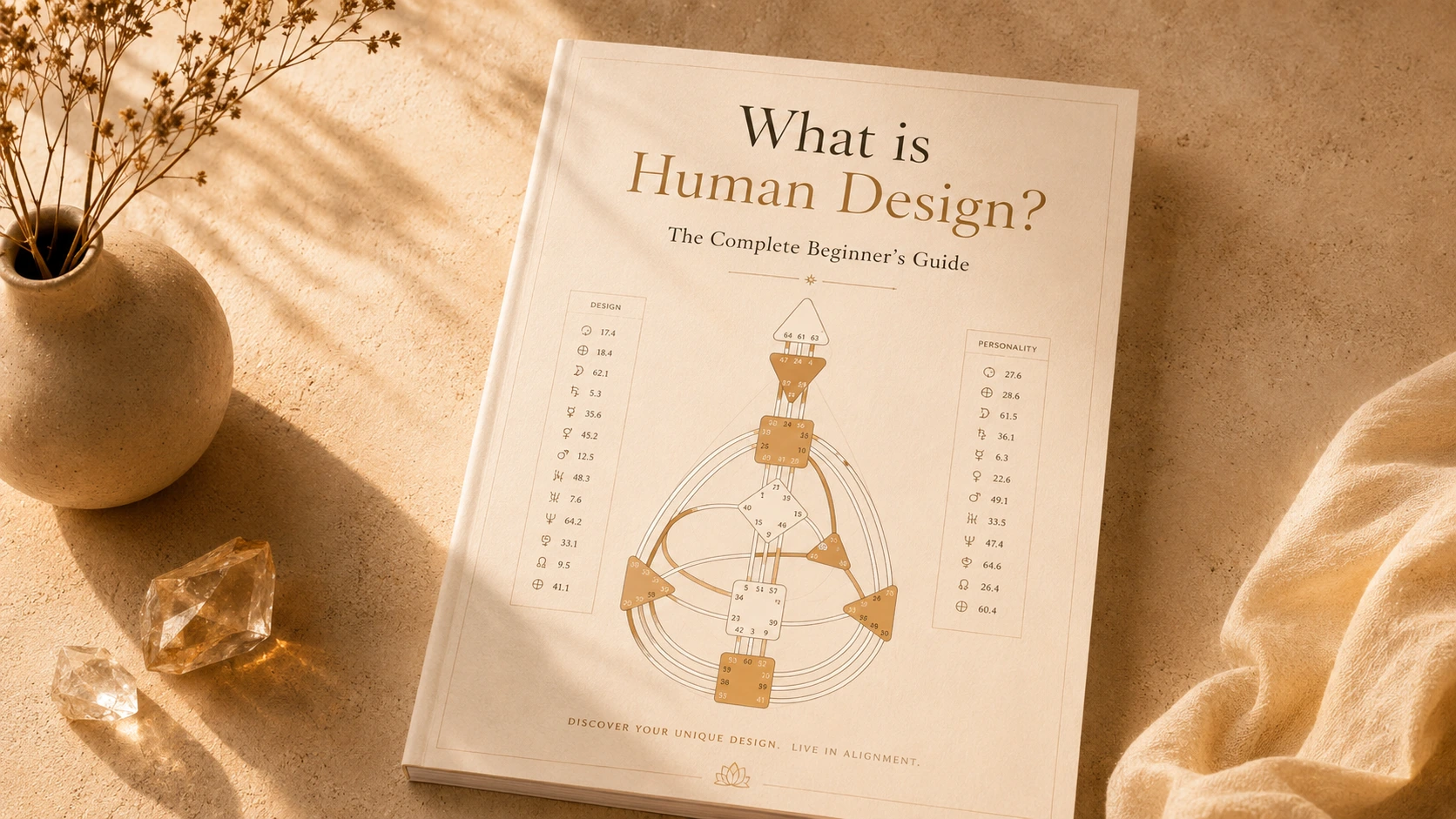
Manifestor: the initiator who doesn't need permission
Manifestors make up approximately 8% of the population and have a closed, repelling aura. They are the only type in Human Design that has a motor (will, emotional, or root center) connected directly to the throat, meaning they have the energy to initiate action without waiting for external response or permission. This gives them an unusual capacity to move things forward that others simply don't have.
The Manifestor's strategy is to inform before they act. Not to ask permission, but to let the relevant people know what they're doing. This matters because the Manifestor's aura can feel impactful or even alarming to others without the Manifestor intending it. Informing reduces resistance and allows Manifestors to move with less friction. The not-self theme for Manifestors is anger, a sign they're meeting too much resistance, often because they've stopped informing.
→ How your type shapes your decision-making
Generator: the builder with sustainable life force
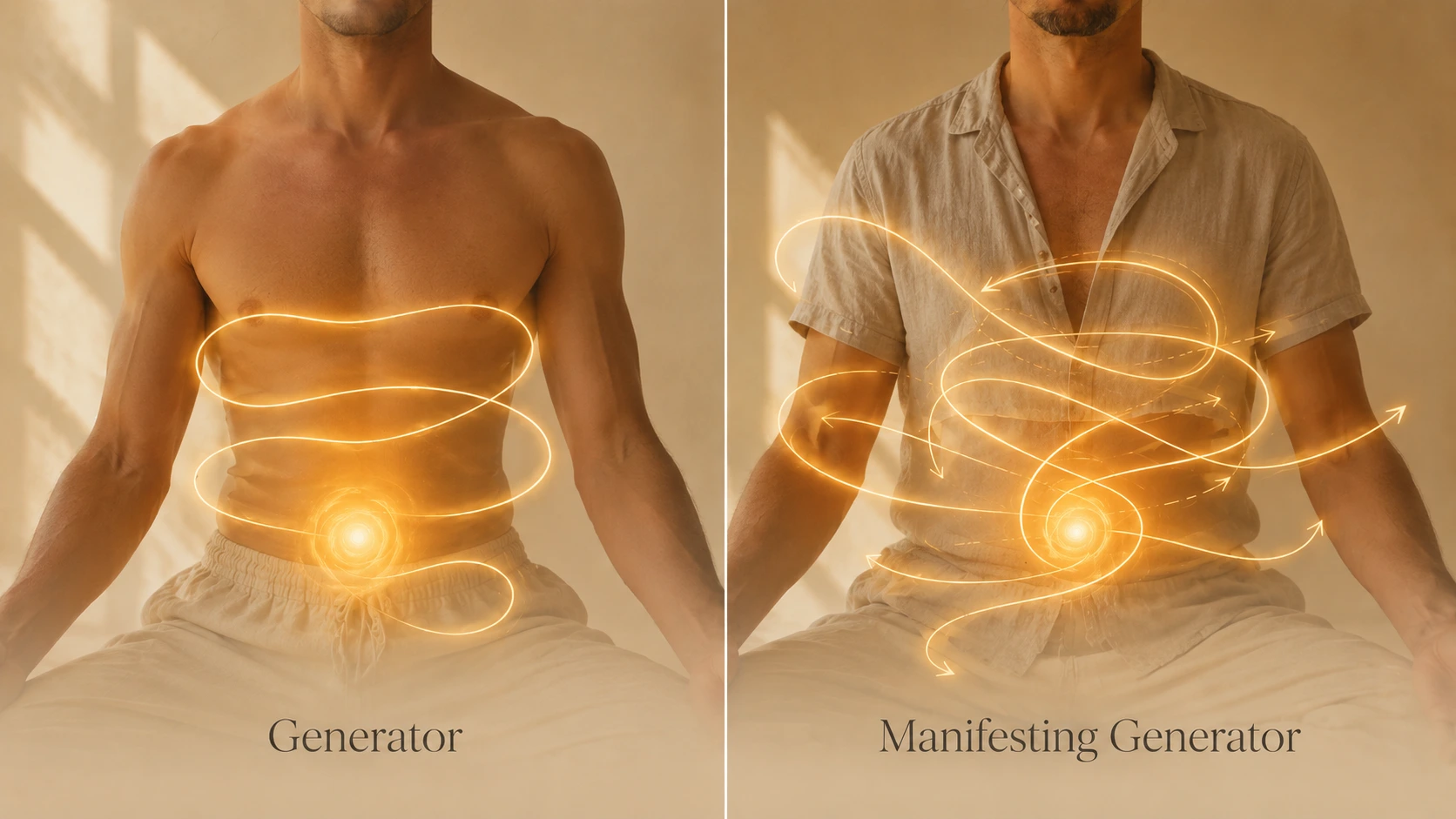
Generators are the most common type, approximately 37% of the population, and have an open, enveloping aura. They are the life force of the planet: the ones with sustainable, renewable energy to build things over time. Unlike Manifestors, Generators don't initiate, they respond. Their energy is designed to respond to what shows up in their environment, rather than pushing forward from nothing.
The Generator's strategy is to wait to respond. Not passive waiting, but an active receptivity to life. When something appears, an invitation, an opportunity, a question, the Generator's sacral center responds with a visceral "uh-huh" or "unh-unh" before the mind has time to analyze it. Learning to trust that response rather than override it is the central practice of Generator life. The not-self theme is frustration, the signal that a Generator has been initiating rather than responding, or saying yes when their sacral said no.
Pro tipIf you're a Generator and you feel chronically frustrated, look at how many of your current commitments started with a mental decision rather than a gut response.
→ Human Design and decision-making: following your authority
Manifesting Generator: efficiency and multi-passionate energy
Manifesting Generators (MGs) are sometimes considered a subtype of Generator, they share the sacral center and the wait-to-respond strategy, but with an important difference: they also have a direct connection from a motor to the throat, giving them the capacity to skip steps that other types cannot. MGs tend to move fast, pivot frequently, and find intense satisfaction in doing multiple things simultaneously.
The MG's challenge is the expectation of linearity. Society, and most productivity advice, assumes that the right approach is to pick one thing, commit fully, and see it through. For MGs, this is often a recipe for misery. They're designed to be multi-passionate, to revisit things they've left behind, and to find shortcuts that others miss. The not-self theme for MGs is also frustration (and sometimes anger), often appearing when they've been forced into a single lane or when they've rushed past their sacral response.
Projector: the guide who waits for the invitation
Projectors make up approximately 20% of the population and have a focused, penetrating aura. They don't have consistent access to the sacral life force, which means they're not designed to sustain the same output as Generators over time. What they do have is an unusual capacity to see into systems and people, to understand how things work and how they could work better. Projectors are the natural guides and managers of the population.
The Projector's strategy is to wait for the invitation, specifically for recognition and invitation from others before offering their guidance. This is counterintuitive in a world that rewards self-promotion. But when a Projector's insights are invited rather than pushed, they land differently, they're received, integrated, actually used. When Projectors initiate guidance without an invitation, it tends to be met with resistance or ignored. The not-self theme for Projectors is bitterness, which arises when they've been giving their gifts without recognition.
→ What is Human Design: the complete guide
Reflector: the rare mirror of the collective
Reflectors are approximately 1% of the population and have a teflon aura, resistant rather than absorbing. Unlike all other types, Reflectors have no defined centers in their BodyGraph. Every center is open, meaning Reflectors are designed to sample and reflect back the energy of the people and environments around them. A Reflector in a healthy, aligned community will feel well. A Reflector in a toxic environment will suffer acutely, and their experience is often the most accurate indicator of that environment's health.
The Reflector's strategy is to wait a full lunar cycle before making major decisions, approximately 28 days. Because Reflectors don't have consistent internal signals, they need to observe how they feel about a decision across the full spectrum of the lunar cycle before committing. This is perhaps the most difficult strategy to practice in modern life, where quick decisions are expected. The not-self theme for Reflectors is disappointment, the signal that they've been rushing decisions or surrounding themselves with people and places that don't support them.
Key takeawayYour type is your aura and your energy signature, not a personality label. Two Generators can be completely different people. Type tells you how to move through the world, not who you are.
Want to understand your type in the context of your actual life?
Type is the beginning. In coaching, we use it as a living framework, applied to decisions, relationships, and how you work.
Book a free discovery call
30 min · Free · English or French